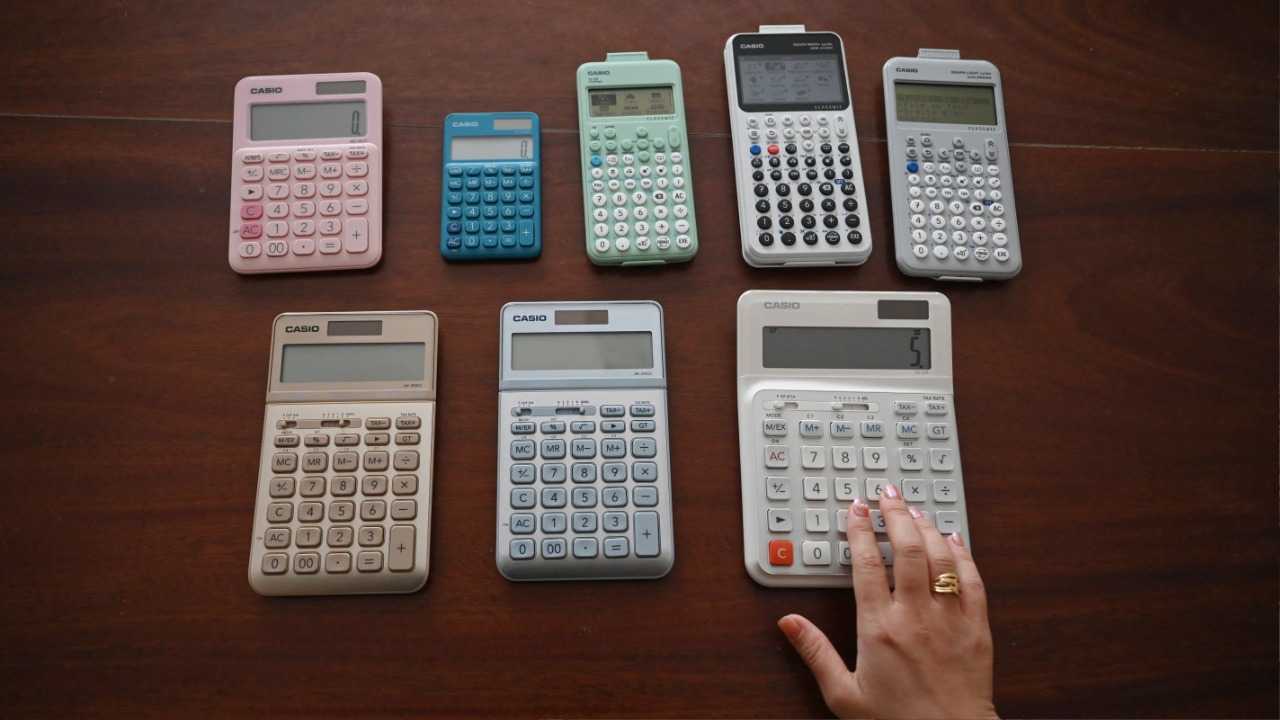
Number's up: Calculators hold out against AI
The humble pocket calculator may no longer match the advanced mathematical abilities of modern technology, but it remains unfailingly reliable. Millions of units are sold each year by Japan’s Casio, which continues to explore expansion in certain regions. Unlike chatbots, which can stumble on simple arithmetic despite lightning-fast advances in artificial intelligence, calculators consistently deliver the correct answer.
“Calculators always give the correct answer,” Casio executive Tomoaki Sato told AFP. Yet he acknowledged that, like the abacus before it, the personal calculator may one day fade from prominence. “The market for personal calculators used in business is on a downward trend,” Sato said, noting that smartphones and web browsers can handle everyday sums, while AI models recently achieved gold-level scores at a prestigious global mathematics contest.
However, calculators still hold advantages. They are more affordable than smartphones and operate on batteries or solar power—benefits particularly appealing to schools in developing countries, a potential growth market for Casio. Users also appreciate the tactile experience. Thitinan Suntisubpool, co-owner of a shop selling red bags and beckoning cats in Bangkok’s Chinatown, praised her large, durable calculator, which has survived several drops. “It’s more convenient in many ways,” she said, noting it helps avoid language-barrier misunderstandings when dealing with customers.
Yet not all vendors share this optimism. At a nearby street stall selling clocks, torches, and calculators, a vendor named Da described sales as “quiet.” Despite this, Casio’s factory in Thailand shows ongoing demand. Assembly line workers slot circuit boards and pop cuboid buttons into pastel-blue calculator frames. “Not everywhere in the world has smartphone connectivity, and calculators are optimized tools focused on necessary functions,” said Ryohei Saito, Casio’s general manager in Thailand.
In the year to March 2025, Casio sold 39 million calculators, both general and scientific, across roughly 100 countries. This is down from 45 million in 2019-20 but up from 31 million in the year following the Covid-19 pandemic. Casio’s journey began with the 1957 invention of the desk-sized “14-A,” its first compact all-electric calculator. Calculator history even made headlines recently when Christie's suspended the sale of the 1642 “La Pascaline,” considered the first machine to substitute the human mind.
Meanwhile, AI is advancing rapidly. In July, models by Google, OpenAI, and DeepSeek achieved gold-level scores at the International Mathematical Olympiad (IMO), though five human participants still achieved perfect marks. IMO president Gregor Dolinar described AI progress in mathematics as “fascinating” and noted that today, students can rely on AI to solve complex problems rather than physical calculators. He believes that calculators will “slowly disappear” as more students turn to phones and AI for calculations.