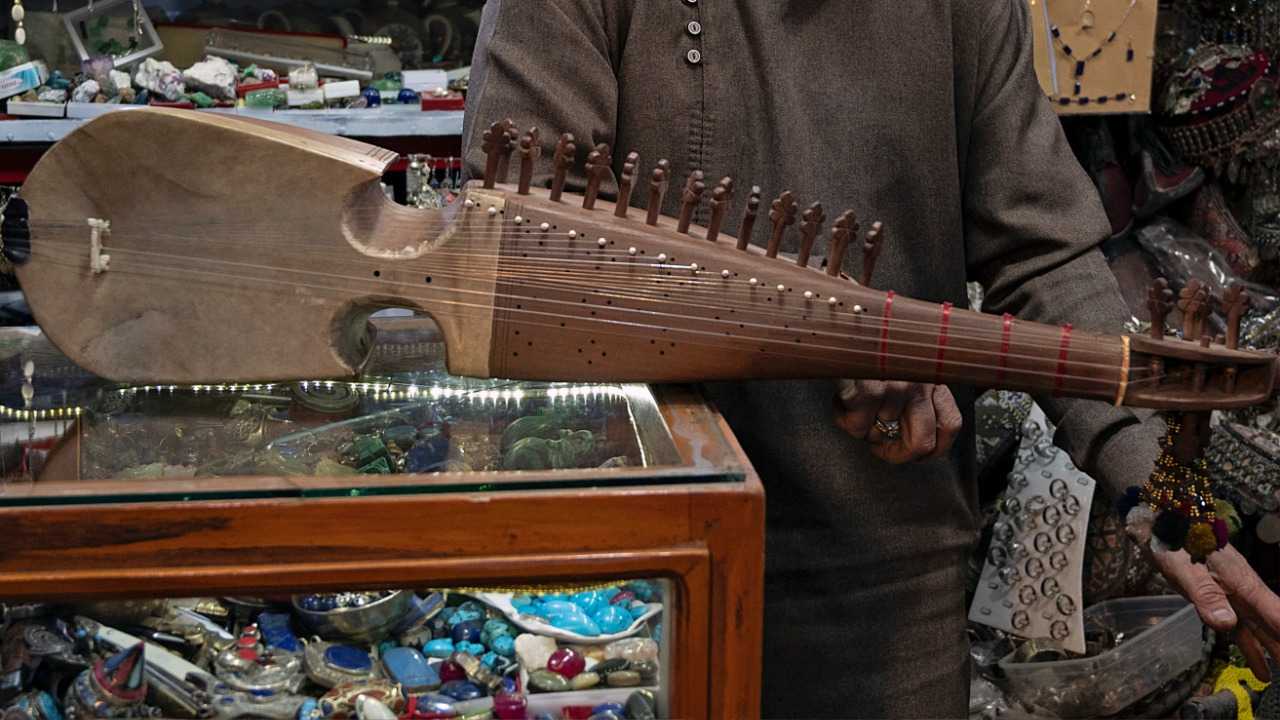
UNESCO-listed musical instrument stifled in Afghanistan
Wood shavings littered the floor of Sakhi's cramped workshop in Herat, Afghanistan, as he meticulously shaped another rubab, the national musical instrument of his homeland. For decades, Sakhi has crafted two rubabs each month, refusing to set down his tools despite the Taliban's crackdown on music.
"I know only this work, and I need to make a living," he said, surrounded by rubabs in various stages of completion. However, for Sakhi, the cultural value of his craft is far more important than financial necessity. In his fifties, using a pseudonym for safety, he emphasized, "The heritage must not be lost."
UNESCO recently recognized this heritage, declaring the art of crafting and playing the rubab as intangible cultural heritage in Afghanistan, Iran, Tajikistan, and Uzbekistan. Made from dried mulberry wood and often inlaid with mother-of-pearl, the rubab is one of the oldest instruments in the region, its twanging sound echoing through centuries.
Yet, this rich heritage is at risk under the Taliban's near-total ban on music, deemed corrupting by their strict interpretation of Islamic law. Since reasserting power in 2021, the Taliban has prohibited public music, from live performances to background tracks, and has even shut down music schools, destroying instruments in the process.
Many Afghan musicians have fled, fearing for their safety or seeking work in a country where jobs are scarce. The Taliban encourages former musicians to turn their talents to Islamic poetry and unaccompanied vocal chants—music forms allowed under their earlier rule.
Amateur rubab player Gull Agha recalls a time when music thrived. After the Taliban's return, they destroyed one of his rubabs and forced him to stop playing. Still, he strums a self-made rubab for tourists, motivated to keep his country’s musical heritage alive. "It's our duty to pass on our local music," he said.
Majid, a former staple of Kabul’s music scene, hadn't played in over three years due to fear. Yet, he hopes to preserve the rubab's legacy, affirming, "As long as I live, I will keep it with me... Music is never lost." Despite the challenges, the spirit of Afghan music remains resilient, echoing through the hearts of its people.